







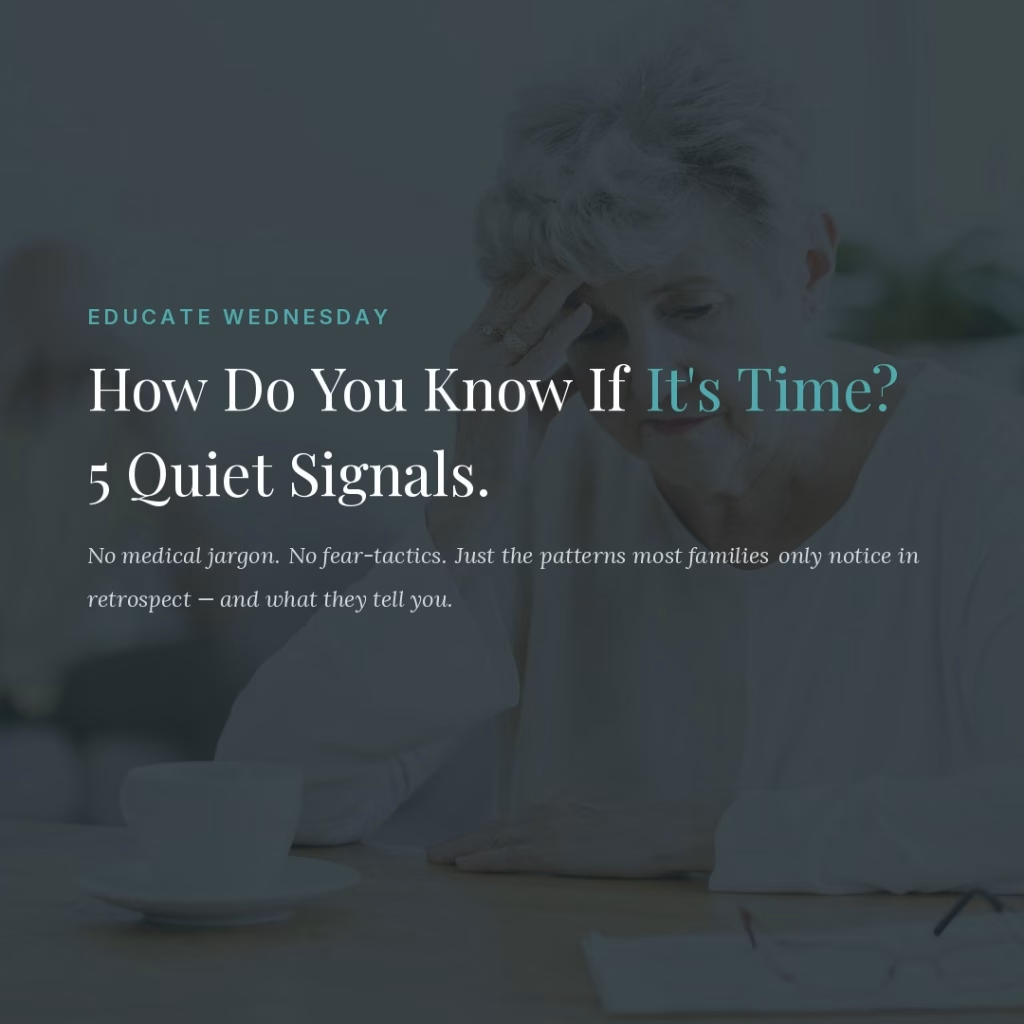
Most families don’t decide it’s time for senior living in a single moment.
There’s no alarm bell. No phone call from a doctor that hands you the answer. There’s just a slow drift of small observations — a forgotten medication, a fridge that hasn’t been restocked, a phone call where Mom told the same story she told you on Tuesday. None of those things, on their own, mean anything. Strung together, over months, they’re the early version of something most families only recognize in retrospect.
The hardest part of recognizing that “it’s time” isn’t denial. It’s that the signals are quiet by design. They don’t announce themselves. They don’t show up on a medical chart. They show up in the kitchen, in the medicine cabinet, in the way the mail starts piling up by the front door. And by the time they’re loud enough to be undeniable, the family is usually six months past the moment when an unhurried plan would have been possible.
The point of this blog post isn’t to scare anyone into a decision. The opposite, actually. The families who recognize these signals six months early are the ones who get to plan — not react. They tour at their own pace. They involve the parent in the decision. They make a move from a place of choice instead of a place of crisis. That’s the difference recognizing the signals early can make.
At Living Your Choice, we’ve helped hundreds of families across eight states navigate exactly this moment. Below are the five signals we hear from families more than any others — the patterns most families notice only when they look back. None of them are diagnostic on their own. Together, they’re a conversation worth having.
Signal #1: The Fridge Tells the Story First
The kitchen is the most honest room in any aging adult’s home.
Long before the doctor’s office picks up on cognitive changes, long before the kids notice anything off in conversation, the fridge starts telling on itself. Same items. Same expiration dates. The grocery list stops growing — and so does what’s actually getting eaten.
Here’s what to look for the next time you’re at Mom’s house:
Are the same items there as last visit, untouched? A half-empty carton of yogurt sitting since March. A bag of salad turning to slime in the crisper drawer. Bread that’s been opened and not finished. These aren’t signs of carelessness. They’re signs that the cognitive load of meal planning has gotten quietly heavier — and the path of least resistance is to not eat much at all.
Are the expiration dates piling up? Milk three weeks past. Lunchmeat from last month. Condiments that have been there since the holidays. The act of throwing food away requires noticing it’s expired, which requires reading the date, which requires attention that’s increasingly going somewhere else.
Is the variety shrinking? When we’re stressed or tired, we eat the same five things. When we’re cognitively overloaded, we eat the same two. A fridge with broad variety three years ago and only crackers and cheese now is telling you something about energy, not appetite.
According to the AARP and the National Institute on Aging, unintentional weight loss and reduced dietary variety are among the earliest indicators that an older adult is struggling at home — often appearing months before any formal diagnosis. The kitchen sees it first because the kitchen is where the daily work of independent living actually happens.
Signal #2: Medication Starts Living Out of Order
A senior’s medication routine is the most reliable system in the house. Until it isn’t.
The system she ran for 40 years — pick up the prescription, fill the pill organizer on Sunday night, take the morning ones with breakfast — is a sophisticated piece of executive function. It involves planning, sequencing, memory, and self-monitoring. When any of those start to slip, the medication system is often the first place it shows.
What to look for:
The pill organizer is out of sequence. Sunday’s compartment has Wednesday’s pills. Friday is empty when it shouldn’t be. The grandkids’ Sunday-night ritual of helping Grandma fill the organizer has quietly become a recovery operation, not a maintenance one.
Refills are happening too often — or not often enough. Pills double-counted. Pills skipped. A 30-day supply finishing in 18 days, or stretching to 50. Both are signs that the system is no longer being run by a consistent process.
New prescriptions get added but old ones never get reviewed. A typical senior on five medications may, three years later, be on nine — because each visit adds something but no visit subtracts. The complexity itself becomes a cognitive load, and at a certain point, the system breaks under its own weight.
This is the signal that comes with real safety stakes. According to the American Journal of Managed Care, medication non-adherence among older adults contributes to over 125,000 preventable deaths annually in the U.S. — and many of those situations begin not with willful non-compliance, but with a quiet erosion of the systems that used to manage it. If the medication routine is breaking down, the right next step isn’t a lecture about taking pills. It’s a conversation about the level of support the routine now needs.
Signal #3: The Paperwork Starts Piling Up
Unopened mail by the front door. Late notices on bills she’s paid faithfully for 30 years. Catalogs stacking up. Bank statements unopened.
This signal is uniquely heartbreaking because it tells the story of a once-organized adult losing ground on the small administrative tasks that used to define her competence.
Unopened mail isn’t laziness. It’s overwhelm. The act of opening, reading, sorting, and responding to mail involves multiple cognitive steps — and when one of those steps starts to feel hard, the natural response is to put the whole stack aside “for later.” Later doesn’t come. The stack grows. The world is still arriving — she’s just not opening it anymore.
Late notices on routine bills. Electricity, water, the cable. These are bills that were on autopay for years, or that she paid promptly by check every month for decades. A first late notice can be a fluke. A second one is a pattern. A third is a signal.
Duplicate payments or missed payments. Sometimes the same bill gets paid twice, two weeks apart, because the first one was forgotten. Sometimes it doesn’t get paid at all, because she remembers writing the check but never actually did.
A scam she would have caught a year ago. This one matters. According to the Federal Trade Commission, adults over 65 lose more than $1.7 billion annually to financial scams — and many of these losses begin with mail-based or phone-based schemes that the senior would have spotted instantly five years ago. A quiet decline in financial vigilance is one of the costlier signals to ignore.
The paperwork pile isn’t an organizational issue. It’s a signal that the executive function required to run an adult life is asking for help.
Signal #4: The Same Story, Three Times a Week
This signal is the most emotionally complicated.
Every aging parent repeats themselves sometimes. Every adult child has heard a beloved story for the hundredth time. That’s not what we’re talking about.
What we’re talking about is when the same story — sometimes a small one — comes up two or three times in the same conversation, or two or three times in the same week, as if it’s being told for the first time each time. The loop is getting tighter. And the person inside it doesn’t realize they’re inside it.
What to listen for:
The same anecdote in the same call, fifteen minutes apart. “Did I tell you about the woman at the grocery store?” Yes, Mom. Ten minutes ago. The repetition isn’t conversational filler. It’s the short-term memory not registering that the story was already shared.
A question asked, answered, then asked again the next day as if for the first time. “When are you coming for Christmas?” “Mom, we talked about this — Christmas Eve.” The next day: “When are you coming for Christmas?” This is not forgetting. This is the new information failing to encode into memory at all.
The same financial concern, the same medical question, the same logistical worry, surfacing repeatedly with no memory of having raised it before. This is the cognitive version of the late notice. The system that holds new information together is starting to slip.
It’s important to be careful here. Occasional repetition is normal. The pattern that signals something deeper is increasing frequency, especially of recent events being lost while older memories remain intact. According to the Alzheimer’s Association, this kind of short-term memory disruption — vivid recall of childhood but blank gaps on yesterday — is one of the earliest patterns family members notice in retrospect, often months or years before a formal diagnosis.
The point isn’t to diagnose anything from a phone call. The point is to notice the pattern, and to gently have the conversation with the rest of the family about what you’re observing — together.
Signal #5: The World Gets Smaller. The Chair Gets a Groove.
This is the signal families miss the longest — and remember the hardest.
She leaves the house less. The bridge group dwindled and she didn’t replace it. Church attendance dropped off “just for a while.” The morning walk got shorter, then stopped. Friends call less. She declines invitations she would have accepted a year ago.
There’s a chair in the living room. It used to be the one she sat in to read. Now it’s the one she sits in all day. The chair has a groove. The TV is louder than it used to be. The world hasn’t left her — but she’s gradually stopping leaving the house to meet it.
Social isolation is the senior living signal most associated with mortality. According to the National Academies of Sciences and a landmark Cigna study, prolonged social isolation in older adults is associated with health risks comparable to smoking 15 cigarettes a day — and the rate of cognitive decline accelerates significantly once a senior stops engaging with people outside the household.
What makes this signal so easy to miss:
It’s not a sudden event. It happens by quiet subtraction over 18 to 24 months.
The senior often doesn’t experience it as a problem. “I’m just tired.” “I’d rather be home.” From the inside, it feels like a preference. From the outside, it looks like a loss.
Family members rationalize it. “She’s 84 — of course she’s slowing down.” That’s true. But there’s a difference between an 84-year-old who still has rhythms, peers, and rooms she walks into — and an 84-year-old who has the chair, the TV, and the phone calls from her daughter.
If the world has gotten smaller without anyone choosing to make it smaller, that’s the signal. And it’s one of the most reversible signals on this list — if it’s caught early. Senior living communities with strong programming, peers, and shared meals are, for many seniors, the moment the world expands again instead of continuing to contract.
What These Five Signals Have in Common
Notice what’s not on this list.
Not a fall. Not a hospitalization. Not a diagnosis. The signals above are the ones that show up before the dramatic events — and the families who pay attention to them are the families who get to plan instead of react.
That’s the difference that matters most. A planned move into senior living is a fundamentally different experience than a crisis placement. The planned move involves touring three or four communities. It involves the parent in the decision. It happens over weeks or months, with the family’s preferred timing. The crisis placement happens after the fall, after the hospital, after the social worker calls. It’s faster, narrower, and almost always harder on everyone — including, especially, the parent.
You noticed. That’s already the hardest part. The families who recognize these signals six months early are the ones who get to choose the next chapter, instead of having it chosen for them.
A Word for Families Who Aren’t Sure Yet
If you’re reading this and recognizing two or three of these signals — but you’re not sure it’s time yet — that’s actually the right moment to call us.
We don’t only help families who are ready to move tomorrow. The families who call us six months early are often the ones with the best outcomes, because we have time to walk the journey at the parent’s pace. Sometimes that conversation ends with “let’s stay home with more support for now.” Sometimes it ends with a tour of three communities. Sometimes it ends with a deeper family conversation that hadn’t happened yet.
There’s no script. There’s no quota. There’s nothing to sell you. Our service is 100% free to families — paid by the communities we partner with, only after a family moves in. The same conversation we’d have with our own parents is the conversation we have with yours.
The Bottom Line
The hardest part of the senior living conversation isn’t the decision. It’s the noticing.
The fridge. The medication. The mail. The repeated stories. The smaller world. None of them are loud. All of them matter.
If you’ve read this whole post and recognized your parent in two or three of these signals, that’s not a verdict. It’s a conversation. Have the conversation early — with siblings, with the parent, with a senior living advisor who can walk you through what the options actually look like in your area.
The families who do this six months early are the families who get the move-in story they wanted. Not the one they had to settle for.
Your Next Step
Living Your Choice helps families across Florida, California, Illinois, South Carolina, Pennsylvania, Alabama, Arizona, and Georgia find the right senior living community for their loved one. We’re 100% free to families. No call center. No pressure. We listen first, and we keep showing up — long after the move-in date.
If you’ve recognized your parent in this post and you want to talk to someone who’s walked this conversation hundreds of times — without selling you anything — start here: livingyourchoice.com/senior-living-placement-search/.
We’ll listen. We’ll walk you through it at your pace. And if it turns out the right answer is “not yet,” we’ll tell you that too.
